Posts mit dem Label animal mascots werden angezeigt. Alle Posts anzeigen

Samstag, 24. September 2011

Chimp Ricky from Edinburgh Zoo turned 50...

Geburtstagsfeier für den ältesten Bewohner des Edinburgh Zoo:
Schimpanse Ricky wird 50

Birthday Party for the oldest resident at Edinburgh Zoo:
Chimp Ricky turned 50

Und es gab eine ganze Menge (essbarer) Geschenke...

"High flying chimpanzee Ricky was on top of the world on Monday (19.09.) as Edinburgh Zoo celebrated his 50th birthday.

Ricky can often be seen perched at the highest point of the Budongo Trail, Edinburgh’s specially made chimpanzee home, looking out on a panoramic view of the capital.

Keepers prepared birthday-themed enrichment to celebrate Ricky’s big day, including a gigantic birthday peanut butter flavoured banner and some special chimp-family presents packed with edible treats. "

Obwohl es keine eindeutigen Daten über Rickys genaues Alter gibt, schätzen seine Pfleger, dass er mittlerweile die runde Fünf-Null erreicht hat, was ihn im Zoo zum ältesten Bewohner macht. Ricky teilt seinen Geburtstag mit Primatenpflegerin Sarah Gregory, die an diesem Montag 30 wird.

Leiter der Tiere Darren McGarry sagt: "Ricky ist ein wirklich wichtiges integrales Mitglied unserer Schimpansen-Gruppe und alle Primaten Mitarbeiter freuen sich, seinen Geburtstag zu feiern. Alle Pfleger hier im Edinburgh Zoo haben ein Faible für Ricky."

"Er hat viel Charakter und ist einer der sozialsten und friedlichsten unserer Schimpansen. Er ist kein dominantes Männchen und hat nie viel Interesse an Schimpansen Politik gezeigt. Stattdessen bevorzugt er mit den Jugendlichen der Gruppe zu spielen und auf sie aufzupassen.

"Es ist oft sehr schwierig für Schimpansen wie Ricky, die von ihren Müttern in jungen Jahren durch den illegalen Handel getrennt wurden, und die wenig Kontakt mit anderen Schimpansen hatten, von anderen Schimpansen, die in komplexen sozialen Hierarchien leben, akzeptiert zu werden. Glücklicherweise hat Rickys liebenswerter und sanfter Charakter mit dazu beigetragen, seinen Platz zu finden, und er wurde sehr herzlich von den Schimpansengruppe hier im Edinburgh Zoo akzeptiert. "

Während Ricky wie ein großes Kind erscheinen mag, ist dieser ältere Schimpanse ein wenig eingefahren auf seinen Wegen. Ricky ist der einzige Schimpanse, der von sich sagne kann, eine permanente Schlafstelle deponiert zu haben, in einer der warmen geräumigen Innen-Räume des Budongo Trails, wo er hoch oben thront. Wenn es ums Essen geht, ist er auch ein Gewohnheitstier, so entscheidet er sich zumeist für seine alten Favoriten wie Äpfel, Orangen, Bananen und Brei-Sticks, obwohl er auch eine Vorliebe für gefrorene Frucht-Smoothies entwickelt hat.-

While records don’t give Ricky’s exact age, keepers estimate he has reached the big five-zero, making him the Zoo’s oldest resident. Ricky shares a birthday with primate keeper Sarah Gregory who will turn 30 this Monday.

Head of animals Darren McGarry said: “Ricky is a really important member of our chimp groups and all the primate staff are delighted to be celebrating his birthday. All the keepers here at Edinburgh Zoo have a soft spot for Ricky and most importantly he has become an integral member of our chimpanzee group."

“He has a lot of character and is one of the most caring, peaceful of our chimpanzees. He is not a dominant male and has never shown much interest in chimp politics. Instead he prefers to watch out for and play with the youngsters of the group.

“It is often very difficult for chimpanzees like Ricky who have been taken from their mothers at a young age and who have had little contact with other chimps due to illegal trading to be accepted by other chimpanzees, who naturally live in complex social hierarchies. Luckily Ricky’s lovable and gentle personality has helped him find his place and he has been warmly accepted by the chimpanzee group here at Edinburgh Zoo.”

While Ricky can seem like a big kid, this older chimp is a little set in his ways. Ricky is the only chimp to have claimed a permanent sleeping spot, in one of the warm spacious indoor pods at Budongo Trail, perched up high. He is also a creature of habit when it comes to food, choosing to stick to old favourites like apples, oranges, bananas and porridge though he’s also developed a taste for frozen fruit smoothies.


Rickys Leben begann unter tragischen Umständen, seine Eltern wurden vermutlich im Rahmen des weitverbreiteten illegalen Wildfleisch- und Tierhandels geschlachtet, so dass Ricky eine junge Waise wurde. Während die Details des frühen Lebens von Ricky ein wenig unklar sind, ist bekannt, dass er später als Maskottchen auf einem Schiff der Handelsmarine mitfuhr.

Obwohl Ricky dort gut gepflegt wurde, merkte die Handelsmarine, dass dies kein ideales Umfeld für einen Schimpansen darstellte und sie begannen für Ricky nach einem dauerhaften, geregelten Zuhause zu suchen, in der er Gesellschaft von anderen Schimpansen hätte.

Am 20. April 1966, kam Ricky in Edinburgh Zoo, zu den Schimpansen Liza und Bergie. Seit seiner Ankunft in Edinburgh, hat Ricky einen Platz in jedermanns Herz gefunden, von den Pflegern angefangen über seine Artgenossen dort wird er von allen geliebt.-

Ricky’s life began in tragic circumstances as keepers at Edinburgh Zoo believe his parents were slaughtered in the illegal bush meat and pet trade, leaving Ricky a young scared orphan. While the details of Ricky’s early life are a little unclear, keepers know Ricky went on to become a mascot on a merchant navy ship.

Although Ricky was well cared for, the merchant navy realised they couldn’t provide him with an ideal environment or the company of other chimps and began making arrangements to find Ricky a more permanent home.

On April 20th 1966, Ricky arrived at Edinburgh Zoo, joining chimps Liza and Bergie. Since arriving at Edinburgh Zoo Ricky has won a place in everyone’s hearts, from the keepers to his fellow chimps.

And he spent the day ripping open presents filled with his favourite foods, including baked potatoes, apples, oranges, porridge and - of course - bananas.


Der illegale Handel mit Schimpansen hat weiterhin verheerende Folgen für Schimpansen, die wild in den Regenwäldern von West-und Zentralafrika leben. Für jeden illegal gehandelten Baby-Schimpansen werden schätzungsweise zehn erwachsene Schimpansen getötet.

Seit seiner Ankunft in Edinburgh Zoo in 1966 hat Ricky viele Veränderungen erlebt, eine der größten war der Bau von Budongo Trail, der einen riesigen Außen-Bereich umfasst, wo die Vegetation es den Schimpansen erlaubt zu klettern und Futterpflanzen zu finden, ähnlich wie in einem Regenwald. Die Anlage beinhaltet auch mehrere geräumige Innenräume jeweils mit unterschiedlichem Licht, Feuchtigkeit und Temperatur, so dass die Schimpansen den Ort wählen können, der ihnen gerade am meisten entspricht.

Während Rickys Geschichte ein glückliches Ende hat, verlieren weiterhin viele Schimpansen in ihrem natürlichen Lebensraum und Familien an den illegalen Handel mit Tieren und Buschfleisch.-

The illegal trade in chimpanzees continues to have devastating consequences for chimps living wild in the rainforests of West and Central Africa. For every baby chimpanzee traded illegally an estimated ten adult chimpanzees are killed.

Since arriving at Edinburgh Zoo in 1966 Ricky has witnessed a lot of changes, one of the biggest is the construction of Budongo Trail, the chimpanzee’s state of the art home. Budongo Trail encompasses a huge outdoor vegetation area where the chimps and can climb and forage as they would in the rainforest. The facility also includes several spacious indoor rooms each offering different lighting, humidity and temperature so the chimps can choose their perfect spot.

While Ricky’s story has a happy ending, many chimpanzees continue to lose their natural habitat and family to the illegal pet and bush meat trade.

Belated Happy Birthday, Ricky, and many happy returns!

Sources:
-
News & Events/Edinburgh Zoo
- Edinburgh Zoo throws a party as one of its oldest residents Ricky the chimpanzee turns 50/
Daily Record 20.09.2011

Mittwoch, 25. August 2010

"Bear28" - Going fake for bears' sake...Bärenfellmützen

Wer kennt sie nicht? Die Wachen vor dem Buckhingham Palast sind zwar nicht die einzigen, die diese je nach Perspektive imposanten oder lächerlichen, fast 46 cm hohen Mützen tragen, wohl aber die bekanntesten. Die knapp 3 Pfund wiegenden Mützen sind aus Bärenfell, für jede von ihnen wird das Fell eines kanadischen Schwarzbären benötigt. Offiziere bekommen Mützen von weiblichen Braunbären, ihr Fell ist dichter und voller.

Laut eines Buches von John Whiteclay Chambers II, starteten die Britischen Fußtruppen der Armee um 1670 mit Mützen von Grizzly Bären, seit der Schlacht um Waterloo 1815, also seit fast 200 Jahren werden die Schwarzbärmützen getragen, ursprünglich um bei militärischen Aktionen größer und einschüchternder zu wirken. Die Tradition hat sich bis heute gehalten, auch ohne Schlachten. Alle Soldaten durften damals diese Mützen tragen, die ihnen dann auch persönlich gehörten, heute sind die Mützen Leihgaben. Allein zwischen 2003 und 2008 gab das brit. Verteidungsministerium (MoD) über £320,000 dafür aus. Gekauft werden die Mützen bei einem brit.Hutmacher, der die Felle über internationale Auktionen bezieht. Pro Jahr werden 50 und 100 Felle bezogen, ein Fell kostet um die £ 650. Bei guter Pflege können sie über 100 Jahre halten.

Warum Bärenfelle?Bislang galten sie als nicht austauschbar, ihr Material ist wasserabweisend, offenbar ein wesentliches Kriterium im von häufigem Regen geplagten London, denn bereits (erst!) 1993 gab es erste Vorstöße seitens einiger Abgeordneten für Mützen, die nicht aus Tierfellen stammen, für andere Einheiten, wie die ursprünglich leopardenfellbeschürzten Trommler, gibt es schon seit längerer Zeit künstliches Ersatzfell, eigenen Tests zufolge war es bislang nicht möglich ein Material zu entwickeln, das dieselben Qualtätsmerkmale aufweist.

PETA hat nun in Zusammenarbeit mit Stella MacCartney einen Durchbruch verzeichnet, ein aus Plastikfasern entwickelter Prototyp scheint Tests in Bezug auf wasserabsorbierende und kühlende Eigenschaften bestanden zu haben. An der Technologie, kurz "Bear 28 " genannt, hat MacCartney mit PETA seit 4 Jahren gearbeitet. Man ist nun gespannt, wie das brit. Verteidigungsministerium reagiert. Ein erstes Treffen war für Ende Juli vorgesehen...Hoffen wir also, dass es bald ein Ende mit diesen unrühmlichen Mützen aus Bärenfell hat!

Between 2003 and 2008 the Ministry of Defence (MoD) spent just over £320,000 on bearskin hats. For each hat of 45.7 cm (18 inch) height, the skin of one Canadian black bear is needed.
"The standard bearskin of the British Foot Guards is 18 inches tall, weighs 1.5 pounds , is made from the fur of the Canadian black bear. However, an officer's bearskin is made from the fur of the Canadian brown bear as the female brown bear has thicker, fuller fur, and is dyed black. The British Army purchase the hats, which are known as caps, from a British hatmaker which sources its pelts from an international auction. The hatmakers purchase between 50 and 100 black bear skins each year at a cost of about £650 each. If properly maintained, the caps last for decades; some caps in use are reportedly more than 100 years old."

According to a book by John Whiteclay Chamber II, the British Army foot guards started wearing tall grizzly bearskin fur hats already in the 1670s. In 1815, after the Battle of Waterloo, all soldiers were allowed to wear fur caps. Whereas in the past, each man owned his own hat, today each battalion receives a bearskin hat on loan when assigned to ceremonial responsibilities at Buckingham Palace in London.

"Initially the big bear fur hats were intended to make soldiers look taller as they marched over hills in battle, but they haven't been worn in action for over a hundred years."
Other fur, like the leopardskin aprons worn by ceremonial drummers, has already been replaced with fake versions."

Could Guards wear Stella McCartney synthetic bearskin?

"For almost two centuries the Army's Guards regiments have been decked out on ceremonial occasions in real bearskin hats.

Tourists come to marvel at them at Buckingham Palace.

But the Guards could soon be wearing a faux-fur version, designed by the vegetarian Stella McCartney.

On Thursday a delegation from People for the Ethical Treatment of Animals (Peta) is meeting Peter Luff, minister for defence equipment, support and technology, to propose their animal-friendly alternative.

Peta claims the plastic-fibre hat now meets rigorous Ministry of Defence water repellency tests, after years working on a technology called Bear28.

The hats are also fitted with air vents to keep wearers cool on parade.

McCartney said: "Historically, England has a very high regard for animals, so it makes perfect sense that the MoD should continue shedding ceremonial furs from uniforms.

"Initially the big bear fur hats were intended to make soldiers look taller as they marched over hills in battle, but they haven't been worn in action for over a hundred years.

"I've been working on this with Peta for a few years now and am really happy with the final product, as I hope the MoD will be when they see it."

Dan Matthews, senior vice-president at the animal rights group, added: "In 2005 the MoD carried out specific weather tests on their own prototype which failed on water absorption levels.

"After four years working on this hat, we carried out the same tests at the same test centre and it passed."

He claimed it was a "win-win situation" as the synthetic hats were cheaper than real bearskins, 230 grams lighter "and the bears will certainly be happier".

However, while the MoD said it "remains open" to new ideas, a spokesman stressed it would not be chucking out the original bearskins anytime soon.

They are worn infrequently, need little maintenance and last many years, she explained.

She said: "The MoD remains open to testing material that industry might offer us to asses whether a faux fur meets the requirements for a replacement bearskin hat material. So far industry has not been able to produce a suitable material to meet the Guards' requirements."

She also stressed: "All bearskins used in the UK are sourced from Canada where bears are culled under the direction of the Canadian government to keep the bear population under control."

Bearskin hats have been worn since the Battle of Waterloo in 1815 where they were taken as a badge of honour by the Grenadier Guards when they defeated Napoleon's bearskin-wearing Imperial Guard."

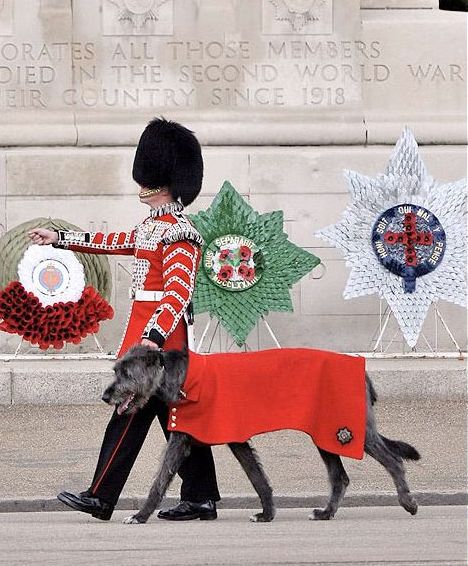
Nur wenigen Truppenmitgliedern ist es gestattet, zeremoniellen Pflichten ohne Bärenmütze nachzugehen wie hier Conmael, Irischer Wolfshund und Maskottchen der Irish Guards.

Kleine Randbemerkung über die sich vielleicht lohnt nachzudenken..:

"Die Tradition von Tiermaskottchen gibt es nicht nur in der Brit. Armee. Sie ist oft ein humorvoller Weg das Eis zwischen Offizieren und Soldaten verschiedenster Ränge zu brechen, so wie auch eine Gelegenheit für das Militär dem Tierreich liebevoll Tribut zu zollen, so wie ihre Vorfahren, die eng mit mit heidnischen Traditionen und der Natur verbunden waren und wo Tiere ein Anrecht auf Respekt, Schutz und Rücksicht hatten.

Doch in keiner anderen Armee wird die Tradition der Würdigung bestimmter Tiere als Maskottchen seit 200 Jahren so respektiert wie in Großbritannien. Ein Land legendär für seine Exzentrik wie für seinen unnachahmlichen Humor."

Übrigens, auch Tabby III, noch besser bekannt als Billy the Goat, nun im Whipsnade Zoo auf Rente, bewies viele Jahre lang, dass es wirklich ohne Bärenmütze gehen kann...-

Only few troup members are allowed not to wear that special head gear like Conmael, an Irish wolfhound and mascot of the Irish Guards....

A little note apart but maybe worthwhile to think about:

"The tradition of animal mascots is not unique to the British Army. It is often a humorous way of breaking the ice between officers and soldiers of all ranks conditioned by the rigidity of Army life. It is also an opportunity for the military to pay an affectionate tribute to the animal kingdom very much like their ancestors for whom pagan traditions and nature were sacredly bonded and where animals just like men were entitled to respect, protection and consideration.

But nowhere has this tradition of honouring a particular animal mascot been so adamantly respected for more than two centuries than in Great Britain. A country known for it's legendary eccentricity as well as inimitable sense of humor." (found here in the context of animal mascots)

By the way, also Tabby III, more known as Billy the Goat, in the meantime enjoying pensioner's life at Whipsnade Zoo had been living proof over numerous years that ceremonial obligations don't need bearskin hats...


Animals Asia unterstützt die Kampagne gegen Bärenfellmützen in der brit. Armee und ruft auf an Vertreter des Parlaments zu schreiben. Mehr dazu hier:

Animals Asia has joined the campaign against bearskin pelts in the British Army too, read full article here and join the campaign:

End the use of bear skin pelts in the British Army/Animals Asia 02.08.2010 (engl.)

Here an extract of their letter:

"More than 200 British Members of Parliament signed on to Early Day Motion (EDM) 1756 in a recent parliamentary session in the House of Commons. This progressive motion pointed out that the ornamental caps serve no military purpose whatsoever – as one of the MPs who support EDM 1756 pointed out, they are not even bullet-proof – and called on the government to support a change to a modern and humane synthetic fabric.

With the resources, science and technology which are at the MoD's disposal, it is inexcusable that the same army which is capable of building some of the most sophisticated equipment and machinery in the world claims it is unable to find a synthetic replacement for bearskins after two decades of "searching" and despite the wide availability of luxurious synthetic materials."

Und zuguterletzt ein eindeutiges Statement eines Angehörigen der dänischen Truppen, der anlässlich eines Balls am dänischen Königshof am 27. Januar unter der Bürde seiner Bärenfellmütze einfach umkippte....Bjoernepels heißen die Mützen auf Dänisch und hier geht es zu einer Seite mit verschiedenen Adressen, wo man seinen Protest kund tun kann. Leider funktioniert der Stop Bjoernepels link zu einer Petition bei mir nicht...-

Last but not least a statement of a different kind of a member of the Danish troups who fainted under the burden of his bearskin hat in the evening of January 27th during a ball at Christiansborg Palace of HM Queen Margarethe II and HRH Prince Henrik, attended by European Parliament members, MPs and their spouses.

Bjoernepels is the bearskin headgear called in Danish and here you find addresses where to send your protest notes. Unfortunately the mentioned petition site does not work for me. Maybe someone knows a link that will work...

And there are still other countries out there using them ....


Sources and related articles:
- End the use of bearskin pelts in the British Army/Animals Asia Foundation 02.08.2010

-
Could Guard Wear Stella McCartney's synthetic bearskin? /Telegraph UK 21.07.2010
- God Save the Bears/PETA Campaign
- New palace bearskins may spare the bear/Guardian 01.09.2008
-
Bärenfellproblem/Modepilot 03.09.2008
- Bärenfellmützen vor dem Aus/Pressetext Austria 03.09.2008
- Bare skin not bearskin.../Daily Mail Online 12.05.2010
-
'Bum Salute' bearskin protesters/Manchester Evening News 02.09.2007
- Kampagne gegen Bärenfellmützen: Parlamentsmitglieder protestieren../
peta de
-
Queen Margarethe of Denmark requires fur from protected bear/Lifescape 16.02.2010 Att.: incl. addresses for petitions to the European Parliament, Danish Parliament & the Danish Royal Family

- More on bearskin hats ... incl. list of nations still using them for military/ ceremonial display on wikipedia

And just that you see that there is still a real market outside for fur....I clicked myself from here to here ..., don't miss the shipment information about polar bear rugs (prices here...)

And here just something else concerning Canada's oldest company & with 550 stores the largest one dealing with furs resolved their financial crisis by getting a new owner...they were bought by an US investor...-